Methodologies
Active learning methodologies in higher education
Challenger universities don't stand out for their technology or their campus, but for how their students learn: solving real challenges, creating projects with impact and integrating disciplines.
Talking about active learning in higher education means shifting the centre of gravity: from lectures and exams to experience, products and evidence. Students stop receiving content and start building knowledge by doing something that matters.
In the Challenger Universities directory we analyse three approaches that appear again and again in the world's most innovative models. They are neither fads nor isolated techniques: they work when the whole institution — curriculum, timetables, assessment and the role of faculty — is designed to sustain them.
The three key methodologies
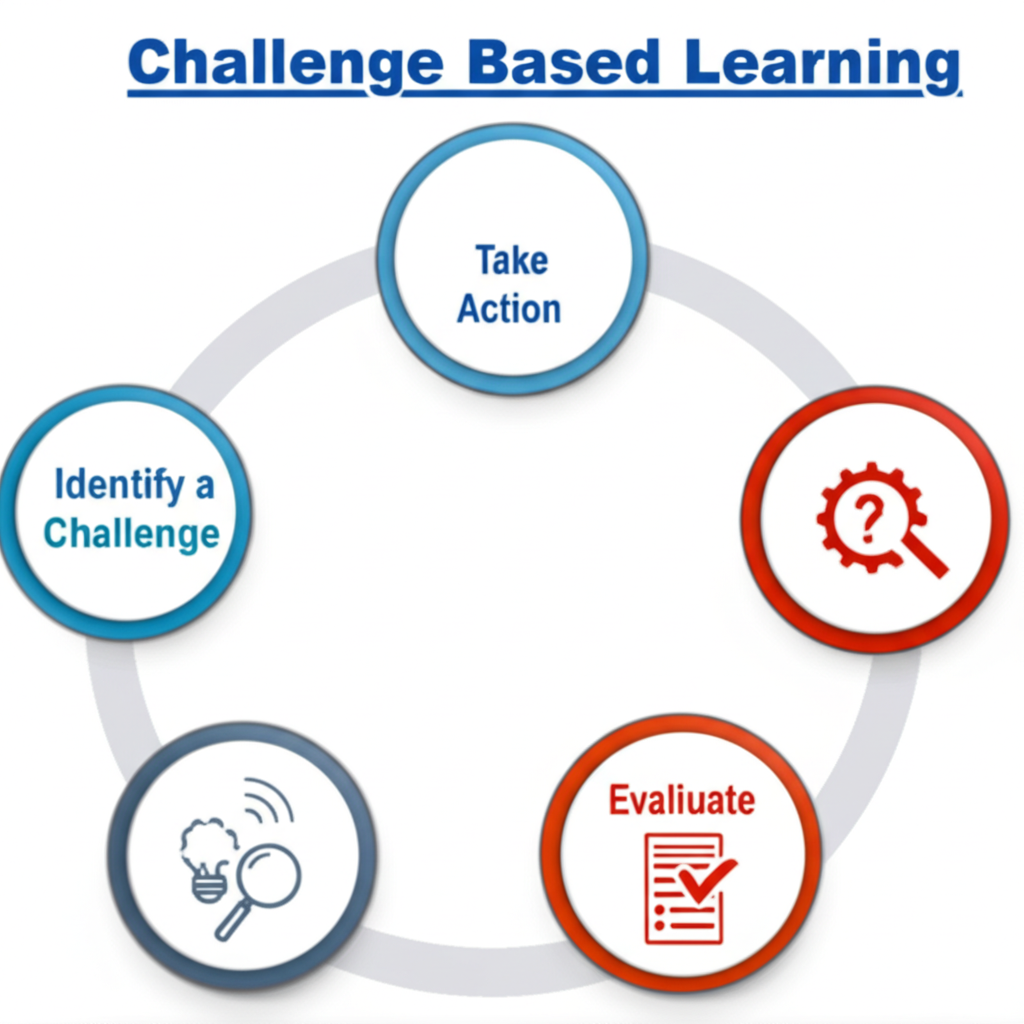
Challenge-Based Learning (CBL)
Teams start from a big idea, frame a real, open-ended challenge, investigate and act with a solution that is tested in the real world.
Challenge-Based Learning guide
Project-Based Learning (PBL)
Learning is organised around authentic, sustained projects that end in a public product: a prototype, a service, a company.
Project-Based Learning guide
Interdisciplinary learning
The foundation: real problems don't respect the boundaries between subjects, so the curriculum shouldn't either.
Interdisciplinary learning guideChallenges, projects and problems: the differences
All three approaches share the idea of learning by doing, but they are not the same. This table summarises where they differ.
| Aspect | Challenge-based | Project-based | Problem-based |
|---|---|---|---|
| Starting point | A big idea and an open, real-world challenge | A driving question and a product to create | A specific problem, often a case |
| Outcome | Not predefined: it emerges from the process and is implemented | A public product defined from the start | A reasoned solution or diagnosis |
| Real-world connection | Very high, with external partners and impact | High; the project can be real or simulated | Medium; often prepared cases |
| Typical duration | Weeks or a semester | From weeks to a whole year | From one session to a few weeks |
| Interdisciplinarity | Essential | Frequent | Variable |
What they have in common
None of these methodologies works as an add-on. When the challenge or project sits alongside a timetable of isolated subjects and final exams, it becomes a peripheral activity that students perceive as extra workload.
The universities in the directory solve this with design decisions: long blocks of time, stable teams, faculty acting as coaches, assessment based on evidence of the process, and partnerships with organisations that bring real challenges.
Reference method
The BeChallenge Method: an architecture for experiential learning
BeChallenge is an experiential learning ecosystem founded in Barcelona in 2017 that combines methodology, technology and expert support so that universities and schools can implement and scale challenge-based, project-based and case-based learning, service-learning and hackathons.
Its starting point is that a method is not a list of activities, but the invisible structure that holds them. That is why the BeChallenge Method is not a rigid sequence: it is an architecture with invariants that adapts to each institution.
The four pillars
Investigate
Inquire before opining: each student explores the problem individually and joins the team with their own point of view.
Connect
Systems thinking: see the system, not just the parts, anticipate consequences and design solutions that consider the whole.
Co-create
Collaboration that leaves a trace: every contribution to the team is visible and traceable.
Evaluate
From grading to development: continuous 360° assessment — self, peers, teachers and external actors — turned into evidence.
The seven reference phases
- 1
Discover
Individual discovery before forming teams: this is where free-riding dies.
- 2
Team
Teams form with perspectives already built, roles and commitments.
- 3
Ideate
Empathy with those who live the problem and co-creation of solutions.
- 4
Feedback
Teachers and external actors come in while the course can still change.
- 5
Prototype
Ideas become tangible, are tested and communicated.
- 6
Voting
Solutions are showcased and selected against transparent criteria.
- 7
Evaluate
360° closing on skills and on the experience itself, turned into graduate-profile evidence.
The method is elastic: 7, 5 or 3 phases with the same architecture. Every phase closes with metacognition (what did I learn and how?) and assessment (what evidence do I leave?), so learning consolidates along the way instead of being examined only at the end.
It builds on Kolb's experiential learning cycle, Dewey's learning by doing, Vygotsky's social constructivism, design thinking, systems thinking, metacognition and assessment for development.
Disclosure: Xavi Pascual, author of Challenger Universities, is the founder of BeChallenge.
Frequently asked questions about active learning
What are active learning methodologies in higher education?
Approaches in which students learn by doing something meaningful — solving a challenge, creating a project, investigating a problem — instead of listening and memorising. Faculty design, guide and give feedback; assessment relies on evidence of both process and outcome.
What is the difference between challenge-based and project-based learning?
In challenge-based learning the outcome is not predefined: the team starts from a big idea, frames a challenge and discovers the solution. In project-based learning it is usually clear from the start which product will be created, and learning is organised around that creation.
Can they be applied in a traditional university?
Yes, but introducing them in a single course is not enough. To scale, timetables, assessment and the faculty role must be redesigned, and the graduate profile must be connected to learning experiences. This is the kind of transformation Xavi Pascual supports with institutions in Europe and Latin America.
Want to bring active learning to your institution?
If you lead a university, business school or education group and want to move from isolated experiences to a coherent model, let's talk on WhatsApp.
Personal reply from Xavi Pascual, usually within one business day.